
Why we exist
Mission defines the organisation’s purpose and the contribution it exists to make.
A management model and its practical development at ANG Group
A theoretical management model developed by ANG Group
into a practical system for governing organisations.
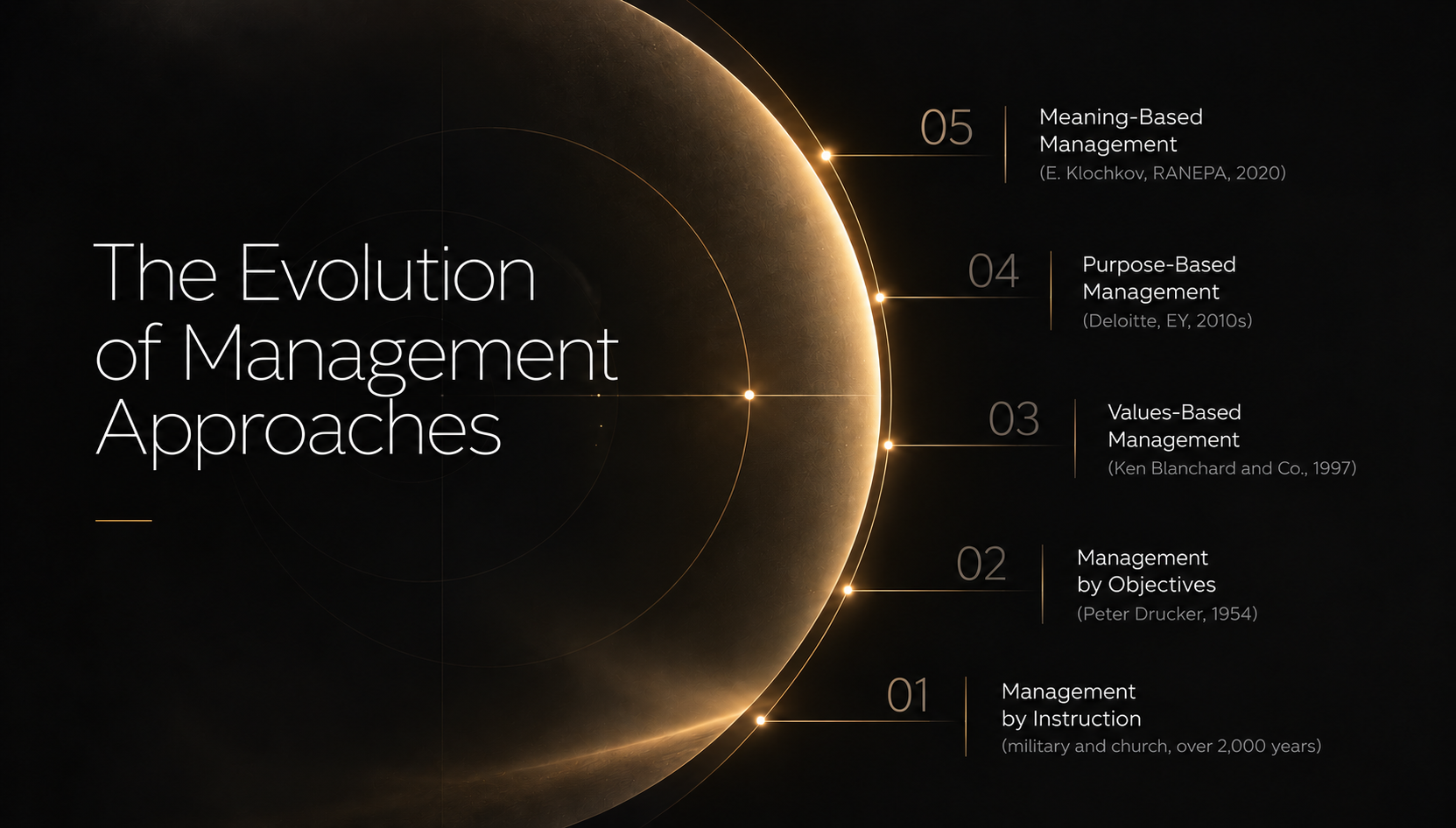
01 / Theoretical model
Meaning-Based Management is a theoretical model in which purpose, identity and values shape an organisation’s strategy, structure and decision logic.
In Ideology: The Power of Meaning, Evgen Klochkov develops this relationship: mission sets direction, values become criteria for choice, and strategy is embodied in the organisation’s design, processes and performance measures.
The model explains how organisational integrity can be sustained by aligning why the organisation exists with how it acts and what outcomes it creates.
Mission defines the organisation’s purpose and the contribution it exists to make.
Identity, archetype and values define the organisation’s character and its boundaries of acceptable action.
Strategy, structure and processes connect purpose with outcomes for clients and stakeholders.
Objectives, KPIs and policies retain their role. The approach connects them to a more fundamental question: which purpose do they help the organisation fulfil?
02 / Practical development at ANG Group
ANG Group has developed Meaning-Based Management into a methodology and a set of practical instruments for founders, organisations and day-to-day decisions.
The Founder’s White Book captures the source of decision logic. The Corporate Constitution translates principles into shared organisational rules. The AI Advisor helps apply them to live management situations. Together, these instruments embody the model at three levels of one management system.
Makes explicit the logic that previously existed in the founder’s experience and intuition.
Through interviews and the analysis of real management situations, the work identifies intent, principles and attitudes to risk, accountability, quality and growth. The founder determines which grounds for decision-making should be transferred to the team and preserved across new ventures.
Practical outcomeA codified founder’s frame of reference that can support delegation and organisational design.
Translates founder intent into shared principles that teams can apply independently.
The organisation’s mission, identity and values are articulated for its specific context. Each value is translated into permissible actions, decision criteria and real dilemmas. Roles, accountability and escalation principles are aligned.
Practical outcomeA shared management framework: teams understand what they may decide independently and when alignment is required.
Supports decisions using the organisation’s own documents, strategy and management logic.
Within Company Genome AI, agreed principles and accessible knowledge become the context for an organisation-specific assistant. The Advisor compares a situation with established rules, reconstructs its decision history and proposes options with reasons and constraints.
Practical outcomeRecommendations grounded in organisational context. Leaders retain accountability for the decision; access to knowledge is defined by user role.
This is a development path, not a mandatory package. The starting point depends on the challenge and the organisation’s readiness; existing documents and rules may provide the foundation.
03 / Implementation
Agreed principles must be reflected in the way work is designed and governed.
Which directions advance the organisation’s purpose, where resources should be committed and which opportunities should be declined.
Which functions are required, who is accountable and where the boundaries of each role’s authority lie.
How accountability is transferred, what constitutes a completed outcome and how functions work together.
How outcomes are measured and whether metrics reinforce the chosen principles and value for the client.
04 / Outcome
The objective is a management system in which decisions are grounded in explicit principles and institutional knowledge.
The founder’s intent is articulated, together with the principles that should endure through growth and the transfer of authority.
There is a shared language, clear criteria for choice and defined boundaries of accountability. Disagreement can be resolved against agreed principles.
Knowledge and decision grounds remain available to future leaders. The organisation can adapt its methods while preserving its identity.
Take several real management situations. Can the team explain a decision through the mission and agreed principles? Is it clear who has authority to act? Is the AI recommendation grounded in current organisational documents? These tests connect the methodology to operating practice.
Questions
Management by objectives specifies the required outcome. Meaning-Based Management adds the grounds for selecting objectives and the means of achieving them: purpose, identity, values and organisational boundaries. Objectives and performance measures remain part of the system.
The White Book articulates the founder’s intent and management logic. The Constitution establishes shared principles for a specific organisation, including decision rules and accountability.
The Advisor helps locate and apply the relevant provisions to a live situation, incorporate decision history and compare options. Its usefulness depends on access to current knowledge, clear rules and a properly defined role.
Begin by testing how they are used in real decisions. Then identify what is missing: clarity of principles, delegated authority, process alignment or access to institutional knowledge.
Next step
We begin with one recurring management situation. Together, we determine which principles need to be articulated, which rules should be codified and where an AI Advisor can support the team.
Discuss a challenge